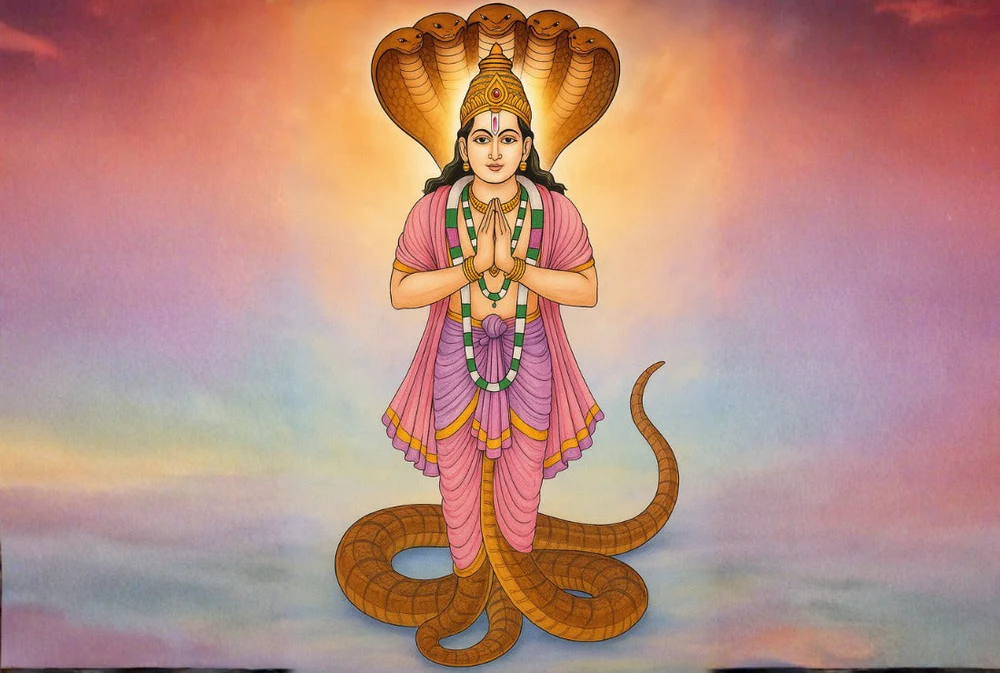
There is a particular kind of seeker who does not accept faith because it is handed down, but burns through every doctrine until only the essence remains. If your birth chart shows Ketu in Krittika Nakshatra in the 9th House, you are likely that seeker. This placement weaves together the mokṣa-kāraka (liberation-giving) energy of Ketu, the fiery razor of Krittika ruled by the Sun, and the vast domain of the navama bhāva — dharma, fortune, father, and guru. It is a placement that can feel like standing too close to a sacred fire: uncomfortable, purifying, and ultimately transformative.
Understanding Ketu and Krittika Nakshatra
The Nature of Ketu
Ketu is not a planet in the physical sense; it is a chāyā graha (shadow planet), the south node of the Moon, and the karaka for mokṣa (spiritual liberation), detachment, and past-life karma. In Jyotish, Ketu represents where we have already been, what we have already mastered, and therefore what we tend to reject in this life. Where Ketu sits, there is an innate familiarity but also a sense of emptiness, a feeling that the usual rewards of that house no longer satisfy. Ketu gives vairāgya (dispassion), psychic sensitivity, and a piercing intelligence that cuts through illusion. However, without the balancing influence of Jupiter or a strong 9th lord, Ketu can also create confusion, doubt, and a tendency to wander without anchor.
As the Brihat Parashara Hora Shastra describes, Ketu is jaḍa — inert yet sharp, like a smoldering ember that burns inwardly. It does not seek worldly expansion; it seeks dissolution. When placed in the 9th house, this energy turns toward the very foundations of belief, religion, and higher truth.
The Fire of Krittika
Krittika (कृत्तिका), "The Star of Fire," spans the latter part of Aries and the early degrees of Taurus. Its presiding deity is Agni, the Vedic God of Fire, and its planetary lord is the Sun. The symbol of Krittika is a razor or flame, indicating sharpness, penetration, purification, and the ability to cut away impurities. This nakshatra carries the energy of dāha (burning) and śuddhi (purification). It is both nurturing and fiercely critical — the fire that cooks the food and the fire that clears the forest.
| Attribute | Details |
|---|---|
| Nakshatra | Krittika (कृत्तिका) |
| De Alteration | Agni (Fire God) |
| Ruling Planet | Sun (Surya) |
| Symbol | Razor / Flame |
| Guna | Rajas |
| Motivation | Kama (desire, later transformed) |
| Key Qualities | Sharpness, purification, authority, criticism |
When Ketu, the planet of detachment, occupies a nakshatra ruled by the Sun and presided over by Agni, the result is a mind that spontaneously rejects authority while simultaneously being drawn toward the essence of truth. The Sun is the natural significator of the 9th house matters (father, dharma, kingship), so Ketu’s placement here creates a direct karmic link to paternal and guru figures. Compared to the more relationship-focused Ketu in Krittika in the 7th House, this placement redirects that sharp fire toward philosophy and ancestral duty.
The Ninth House: Bhagya and Dharma
In Vedic astrology, the navama bhāva (ninth house) is the trikona (trine) of dharma. It governs bhāgya (fortune), dharmic pursuits, higher education (vidyā), long-distance travel, spiritual initiation, the father, and the guru. It is the house of faith — not blind faith, but the accumulated wisdom of tradition. A strong 9th house blesses a native with guidance, ethical clarity, and prosperity through righteous means. When a planet like Ketu, which symbolizes the dissolution of form, enters this house, the native’s relationship with tradition, father, and institutional learning becomes complex. The journey here is from inherited belief to directly perceived truth.
Ketu in Krittika in the 9th House: The Flame of Detached Wisdom
The meeting of Ketu, Krittika, and the 9th house produces a personality for whom viveka (discriminative wisdom) is not optional — it is survival. You are likely someone who questions every spiritual teaching, not out of cynicism, but because your soul remembers a deeper truth and cannot settle for ritual without meaning. The razor of Krittika cuts away the inessential, and Ketu has no interest in the material rewards of dharma anyway. Together, they create a jñāni (knower) who may appear skeptical, even rebellious, but is ultimately driven toward direct spiritual experience.
This placement often indicates a karmic separation or detachment from the father. This may manifest as physical distance, emotional unavailability, or a father who himself was a wanderer or spiritually inclined. The father may have been a strict authority figure (Sun + Krittika), and the native responds by either silently rebelling or completely disconnecting from paternal expectations. In some cases, the father plays a pivotal role in triggering the native’s spiritual search — often through his absence or through a crisis.
The deity Agni presides over speech and digestion of knowledge. With Ketu here, there can be an initial agni-dāha — a burning confusion regarding one’s faith, culture, or university education. You might change your field of study multiple times, leave a degree unfinished, or feel profoundly alienated in academic settings. Yet this same fire, once stabilized, gives the ability to digest profound philosophical texts with uncanny speed. You do not study religion; you metabolize it.
Fortune (bhāgya) in this placement tends to flow in unexpected bursts. Ketu is unpredictable. You may experience sudden windfalls or sudden losses in matters of 9th house significance — a scholarship appears out of nowhere, or a long-awaited pilgrimage gets canceled at the last minute. The lesson is to surrender attachment to how fortune arrives. Unlike the more self-oriented Ketu in Krittika in the 1st House, this 9th house placement asks you to refine your understanding of cosmic order itself.
Personality, Career, and Relationships
Inner Landscape and Behavior
If you have this placement, you probably know the feeling of being the “odd one out” in religious or cultural gatherings. You can sense hypocrisy instantly — Krittika’s razor cuts through pretense, and Ketu has no patience for social posturing. This can make you seem aloof, overly critical, or even arrogant about your beliefs. In truth, you are simply operating from a place of inner knowing that bypasses convention. You may prefer solitary spiritual practice over group rituals. Meditation, fire ceremonies (havan), or minimalist sadhana appeal to you far more than elaborate temple festivities.
There is a natural asceticism here. You are not impressed by titles — “Guru,” “Doctor,” “Swami” — unless the person’s energy matches their words. Your challenge is to soften the sharp edge of Krittika so that your discernment does not become habitual criticism. Not every tradition is your enemy; some are simply steps for others. You might find yourself in a temple feeling nothing, yet weeping during a solitary walk in the mountains. That is Ketu speaking in the language of direct experience rather than inherited form.
Professional Path and Dharma
Career-wise, you are drawn to roles that allow independence of thought and a sharp analytical edge. Fields such as philosophy, comparative religion, academia, research, publishing, law (especially constitutional or international law), and spiritual teaching suit this placement. You may also find fulfillment in foreign service, import-export businesses connected to cultural goods, or as a guide or pilgrimage organizer. The 9th house connection to long travel means your profession may require frequent journeys, or you may work in a multicultural environment.
Because Ketu dissolves ego-attachment to results, you often work best when not chasing promotions. A career that feels like a sevā (service) rather than a ladder to climb will bring more satisfaction. If you are a writer or speaker, your words carry the piercing quality of Krittika — you can be a brilliant debater or a controversial but insightful critic of established systems. Some natives with this placement excel as forensic analysts of ideas, dissecting religious texts, legal precedents, or cultural narratives with surgical precision.
Relationships, Father, and Guru
The 9th house is the pitṛ-bhāva (house of the father). With Ketu here, the paternal relationship is often the primary karmic classroom. You may feel that your father never truly understood you, or that you were raised with rigid ideologies you had to outgrow. In some charts, this indicates a father who was absent, renounced the world, or passed away early. Healing comes when you recognize the father as a catalyst for your own independence rather than a figure to rebel against forever.
In marriage and partnerships, this placement can attract a spouse from a different cultural, religious, or ethnic background (9th house = the “other” in terms of long distance or foreign). You need a partner who respects your mental space and does not demand conventional religious observance. You may delay marriage until you have resolved your own philosophical identity. Once committed, you are loyal but require autonomy. Trying to force you into a traditional family structure usually backfires — your dharma is individualistic.
Guru-related experiences are karmic and sudden. You may reject several teachers before finding one who speaks to your soul, or you may have no formal guru at all, finding your ultimate teacher within through Ketu’s inward pull. When you do meet your guru, the connection is often instantaneous and transformative — Agni’s flash of recognition. This contrasts with the more creatively focused Ketu in Krittika in the 5th House, where the fire is directed toward expression and progeny rather than doctrine and lineage.
Health, Remedies, and Spiritual Practices
Physical and Mental Wellbeing
The 9th house corresponds to the hips and upper thighs. With Ketu here, you may experience occasional stiffness, nerve-related issues, or circulation problems in these areas. Agni’s influence can manifest as excess heat — acidity, inflammation, or skin rashes when stressed. Mental health can be affected by citta-vṛtti (fluctuations of mind) — over-analysis, spiritual anxiety, or a feeling of being “ungrounded” in your beliefs. Regular physical activity that grounds the lower body, such as hiking or yoga, is beneficial.
Practical Remedies
Remedies for Ketu in Krittika in the 9th house focus on honoring the fire of Agni while softening Ketu’s detachment into productive discernment.
- Mantra: Chant Om Kem Ketave Namaḥ daily, especially during Ketu Hora or on Tuesdays. Additionally, the Shiva Sahasranama or Mrityunjaya Mantra helps stabilize Ketu’s scattered energy.
- Agni Worship: Perform havan or agnihotra on Sundays (the day of the Sun, Krittika’s lord) and Tuesdays. Offering sesame (til) and ghee into the fire while meditating on your ancestors and father can be particularly potent.
- Gemstone: A cat’s eye (lehsuniyā) may be worn on the middle finger of the right hand on a Tuesday, but only after proper consultation. If Ketu is afflicted, it is often safer to strengthen the 9th lord or Jupiter instead.
- Charity: Donate blankets, warm clothes, or black sesame to the poor. Feeding dogs — Ketu’s animal — especially on Saturdays, is highly recommended. Supporting the education of underprivileged children also pacifies the 9th house.
- Lifestyle: Maintain a respectful relationship with your father and guru, even if you disagree with them. The karma is resolved through respect, not necessarily obedience. Study one spiritual text deeply rather than sampling many superficially.
💡 Quick Tip: If you feel spiritually restless or cynical, try writing your own spiritual journal rather than reading another teacher’s book. Ketu in Krittika in the 9th house gives original insight — your own words may be the upadeśa (teaching) you have been seeking.
Modifying Factors: Aspects and Conjunctions
No planet operates in isolation. The results of Ketu in Krittika in the 9th house are significantly altered by conjunctions and aspects.
Conjunction with the Sun: Since the Sun rules Krittika, this creates a strong nakshatra-pati connection. It can grant immense spiritual authority and a father who is a significant figure in the native’s dharma. However, it may also create ego battles regarding beliefs — the native must learn to distinguish self-confidence from spiritual arrogance.
Jupiter’s Aspect: If Jupiter aspects or conjoins Ketu here, it forms a powerful dhana-dharma-yoga. The native becomes a wise teacher, and the confusion of Ketu is replaced by structured wisdom. Fortune stabilizes, and the relationship with the guru becomes clearly defined and beneficial.
Saturn’s Influence: Saturn aspecting this Ketu can delay higher education and create a heavy sense of duty toward tradition. The native may feel burdened by ancestral religion but ultimately becomes a strict, disciplined practitioner.
Mars: Mars adds aggression to the sharpness of Krittika. The native may become a militant atheist or a fiery crusader for a cause. Physical energy should be channeled into karma-yoga (selfless service) to avoid argumentative tendencies.
Always examine the navāṁśa (D9 chart) to see if this Ketu gains strength or weakness in the divisional chart governing marriage and dharma.
🔮 Discover Your Complete Chart
See where all your planets are placed — get your free Vedic birth chart now.
Generate Your Kundali →Or ask our AI astrologer for personalized guidance.
Ketu in Krittika in the 9th house is not an easy placement for the faint-hearted believer, but it is a powerful one for the sincere seeker. It asks you to burn away inherited opinions until you stand face-to-face with truth itself — not your father’s truth, not your culture’s truth, but the fire that needs no proof. Trust the process of purification. Respect the father and the guru as karmic gateways, but allow your inner Agni to guide you. In doing so, you transform from a critic of dharma into a living embodiment of it.
— Written by RashibyteAI
No comments yet. Be the first to share your thoughts!