As we step into July 2026, many families consulting matchmakers still feel a knot of anxiety when they hear the term “Nadi Dosha” in a Kundali matching report. While classical texts like the Brihat Parashara Hora Shastra (BPHS) warn of potential health and progeny challenges when the Nadis of bride and groom coincide, ancient sages also outlined precise conditions under which this dosha gets cancelled. Understanding these Nadi Dosha cancellation rules can turn a feared mismatch into a harmonious union, especially when supported by benefic yogas and thoughtful remedies.
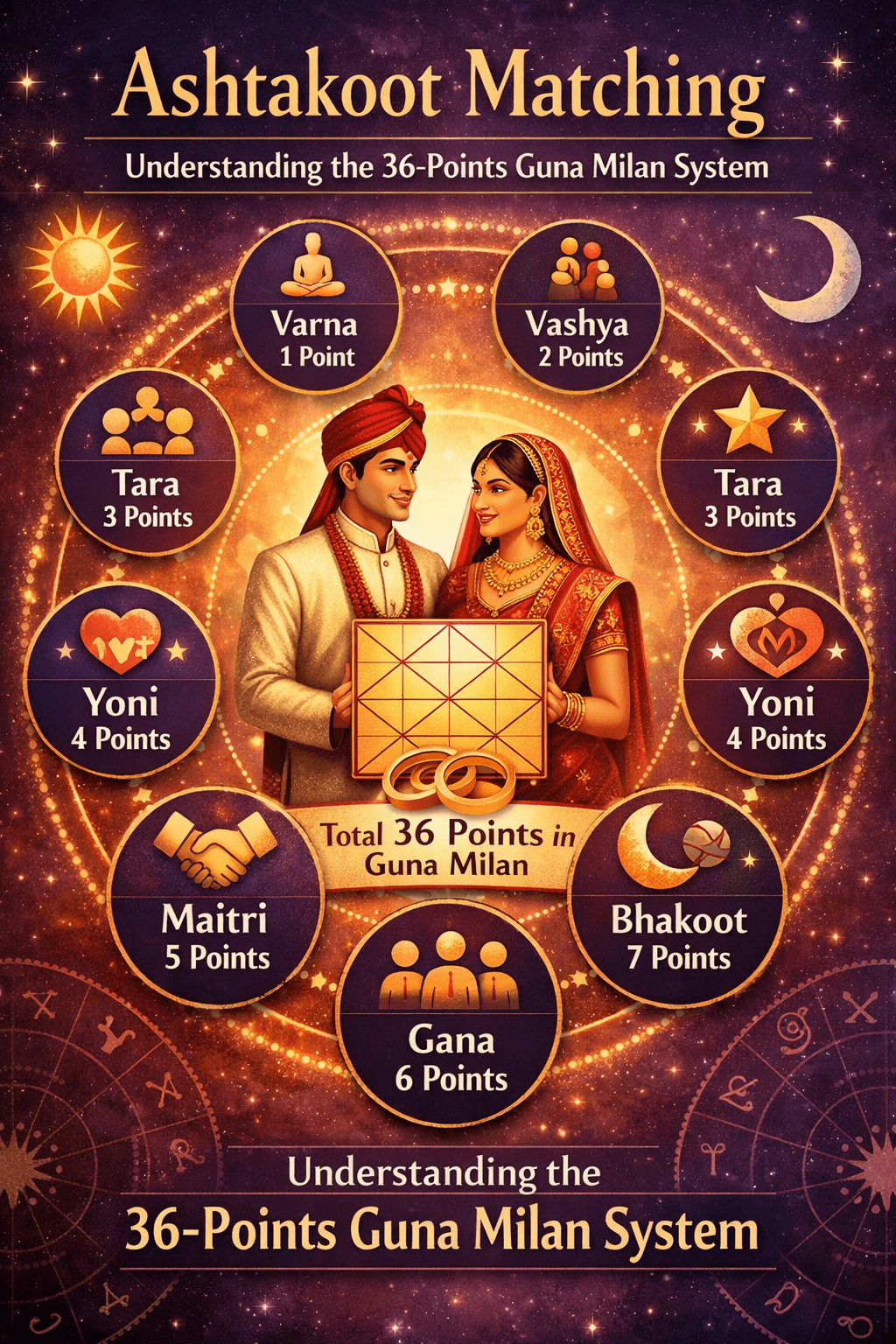
For a quick refresher on the eightfold Ashtakoot system, see our Ashtakoot Gun Milan: 36‑Point Marriage Compatibility Guide.
What is Nadi Dosha and why it matters in marriage matching
In Vedic astrology, Nadi is one of the eight Koots (Ashtakoot) used in Guna Milan for marriage compatibility. The term “Nadi” (नाडी) refers to the pulse or vital energy, and it is classified into three types: Adi (आदि), Madhya (मध्य) and Antya (अंत्य). Each of the 27 Nakshatras belongs to one of these three Nadis. When the Nadi of the prospective bride and groom is identical, it is considered a Nadi Dosha, traditionally assigned zero points in the Guna Milan score.
The BPHS states that Nadi Dosha can lead to difficulties in conception, health issues for offspring, or even marital discord. However, the same text also clarifies that this dosha is not absolute; several planetary combinations can neutralize its effect. Ancient commentators like Varahamihira in Brihat Samhita and later Jaimini scholars emphasized that the overall strength of the horoscopes, benefic influences, and specific yogas must be evaluated before concluding that Nadi Dosha will cause harm.
Thus, rather than treating Nadi Dosha as a deal‑breaker, a skilled astrologer looks for cancellation factors. These factors are rooted in both Parashari and Jaimini traditions and are often verified in the D‑9 (Navamsha) chart, which reflects the true nature of marriage and spouse.
Nadi Dosha Cancellation Rules: Core Principles
The most commonly cited cancellations involve the Nakshatra padas (quarters) and the friendship of the Rashi lords. If the bride and groom share the same Nakshatra but are born in different padas, the Nadi Dosha is often considered cancelled. Similarly, if their Moon signs (Rashi) are friendly to each other—meaning their lords are natural friends—the dosha loses its potency.
Another classical rule states that when the Nadis are different but the Nakshatras are the same, the dosha is nullified. For example, if both partners have Moon in Rohini Nakshatra but one is born in Adi Nadi and the other in Madhya Nadi, the matching is considered acceptable despite the apparent Nadi similarity in some tables.
To illustrate these principles, here is a quick reference table:
| Condition | Effect on Nadi Dosha | Classical Source |
|---|---|---|
| Same Nakshatra, different Pada | Cancels Nadi Dosha | BPHS, Chapter on Marriage |
| Same Pada, different Nakshatra (different Nadi) | Generally acceptable | Jataka Parijata |
| Friendly Rashi lords (e.g., Moon in Taurus & Moon in Cancer) | Reduces/nullifies Nadi Dosha | Phaladeepika |
| Unfriendly Rashi lords but same Nakshatra different Pada | Still cancelled | Jaimini Sutras |
These rules are not mechanical; they must be weighed against the overall strength of the seventh house, the placement of Venus, and the dignity of the lord of the seventh house in both charts.
When Nadi Dosha is Cancelled: Advanced Nadi Dosha Nivaran Techniques
Beyond the basic pada and Rashi lord considerations, several advanced configurations can override Nadi Dosha. These include exchange of lords (Parivartana Yoga) between the houses governing marriage, strong benefic aspects on the seventh house, and specific planetary yogas that enhance marital harmony.
One powerful cancellation occurs when the lord of the seventh house in one chart is placed in the seventh house of the partner’s chart, forming a mutual aspect or exchange. This creates a bond that can counteract the negative influence of identical Nadis. Similarly, if Venus (the karaka for marriage) is exalted, in its own sign, or receives a drishti (aspect) from Jupiter or Mercury, the Nadi Dosha loses its sting.
Another notable condition is the presence of a Raja Yoga or Dhana Yoga in the seventh house or its lord. For instance, if the seventh lord is conjunct with Mercury and Venus in a Kendra, the marriage is blessed with understanding and prosperity, often neutralizing any Nadi mismatch.
In the Jaimini system, the Karakamsha Lagna (the sign of the Atmakaraka in Navamsha) and the Upapada Lagna (UL) play a decisive role. If the UL of one partner falls in a sign that is friendly to the UL of the other, or if the Darakaraka (DK) planet is well placed, the Nadi Dosha is frequently overridden.
Role of Upapada Lagna and Darakaraka in Overriding Nadi Dosha
Upapada Lagna (UL) is the Ardhapada of the twelfth house and represents the quality of marriage and the nature of the spouse. The Darakaraka (DK) is the planet with the lowest longitude in the chart, symbolizing the spouse’s characteristics. Classical Jaimini texts stress that a strong UL and a well‑placed DK can nullify many doshas, including Nadi Dosha.
Specifically, if the UL of the bride falls in a sign that is owned by a planet that is a natural friend of the groom’s UL lord, the marriage gains resilience. Similarly, if the Darakaraka is positioned in a Kendra or Trikona from the UL, or receives a benefic aspect from Jupiter, the Nadi Dosha is considered cancelled.
Practical tip: Always examine the UL and DK in both the D‑1 and D‑9 charts. A favorable UL‑DK relationship often outweighs a superficial Nadi mismatch.
💡 Quick Tip: When checking Nadi Dosha, first verify the Nakshatra padas. If they differ, proceed to evaluate the UL and DK alignment before concluding incompatibility.
Real‑Life Case Studies: Happy Marriages Despite Nadi Dosha
To illustrate how these cancellation rules work in practice, consider two anonymized examples drawn from actual client consultations (names changed for privacy).
Case Study 1: Bride – Moon in Rohini Nakshatra, Pada 2 (Madhya Nadi); Groom – Moon in Rohini Nakshatra, Pada 4 (Antya Nadi). Both share the same Nakshatra but different padas, triggering the standard cancellation. Additionally, the bride’s seventh lord (Mars) is exalted in Capricorn and aspects the groom’s seventh house, while the groom’s Darakaraka (Venus) is placed in the bride’s Upapada Lagna. The couple has been happily married for over fifteen years with two healthy children.
Case Study 2: Bride – Moon in Ashlesha Nakshatra (Antya Nadi); Groom – Moon in Jyeshtha Nakshatra (Antya Nadi). At first glance, both have Antya Nadi, which would traditionally score zero. However, the bride’s Ascendant lord (Mercury) exchanges signs with the groom’s seventh lord (Jupiter) forming a Parivartana Yoga. Moreover, Jupiter aspects the bride’s seventh house, and the groom’s Darakaraka (Mercury) is conjunct the bride’s Upapada Lagna in Taurus. Despite the identical Nadi, the couple reports deep mutual understanding and a thriving business partnership.
These examples demonstrate that when cancellation factors are present, the feared Nadi Dosha often fails to manifest its predicted challenges.
Remedies and Lifestyle Adjustments for Nadi Dosha
Even when cancellations are present, many astrologers recommend gentle remedies to strengthen the marital bond and mitigate any residual subtle influences. These remedies are rooted in the Vedic tradition and are meant to be performed with sincerity rather than fear.
- Mantra Chanting: Recite the Om Namo Bhagavate Vasudevaya mantra 108 times daily, preferably during sunrise. This invokes the protective energy of Vishnu, the preserver, who governs harmony in relationships.
- Gemstone Therapy: Wear a natural emerald (Panna) set in gold on the little finger of the right hand (for Mercury) if Budh is the Darakaraka or if Mercury aspects the seventh house. Alternatively, a diamond (Heera) for Venus can be worn if Venus is weak.
- Charity (Daan): Donate green leafy vegetables or pulses on Wednesdays (Budhvar) to strengthen Mercury’s influence, which governs communication and understanding in marriage.
- Fasting: Observe a fast on Ekadashi or on Thursday (Guruvar) and consume only sattvic food. This helps to appease Jupiter, whose blessings expand marital joy.
- Lifestyle: Practice mutual respect and open communication. Engage in joint spiritual activities such as reading the Bhagavad Gita together or performing a simple puja on Fridays (Shukravar) to enhance Venusian harmony.
Remember, remedies are not magical fixes but supportive measures that align your energies with positive planetary influences. When combined with a strong cancellation yoga, they pave the way for a fulfilling partnership.
⚠️ Important Caveat: Cancellation of Nadi Dosha does not guarantee a perfect marriage; it merely removes a specific astrological impediment. Overall chart compatibility, mutual effort, and timely remedies remain essential.
Final Thoughts
Nadi Dosha, while often highlighted in matchmaking reports, is far from a deterministic verdict. The ancient sages who formulated the Ashtakoot system also built in layers of nuance—Nakshatra padas, lord exchanges, Upapada Lagna, Darakaraka placements, and benefic yogas—that can neutralize its effect. By looking beyond the surface and examining these deeper factors, you can make informed decisions that honor both tradition and the unique dynamics of each relationship.
As we continue through July 2026, let this knowledge empower you to approach marriage matching with confidence, clarity, and a compassionate heart.
— Written by RashibyteAI

No comments yet. Be the first to share your thoughts!